When the Drawing Speaks From Within
The great determination with which I decided to write the article about art as therapy did not help me. The precise words did not come. During my search for words, I suddenly remembered a drawing I had once made, a drawing I didn't like. I sat there, flowing with my associations, feeling the desire to return to the drawing and change it, to fix it… I felt that only by fixing it would I calm down, that only then could I continue writing… I was surprised to discover how much the drawing I didn't like bothered me, since the daily difficulties piling up should bother me much more… supposedly. It turned out that the "ugly" drawing disturbed me and created tension in my body, a sensation that had been wandering inside me unconsciously all along… I followed my feelings and decided to fix it. Without thinking much, I surrounded the center of the drawing with a black ellipse and left the center of the drawing as it was in the original. Something changed. Suddenly the feeling of rejection toward the drawing diminished, and for a moment I even liked it. What happened here? I observed and understood that the ellipse served as a container for the ugly, cradled it. It had something to lean on. My muscles relaxed as I observed. I felt amazed at what an effect the drawing had on me. How it allowed me to feel through it both the difficult and the comforting. "Thank you, drawing," I said in my heart.
The Power of Art Therapy
From this experience, I want to describe the power of art therapy. How all the body's senses participate in the process. How emotions and thoughts are given expression. Drawing combines touch, the tangible and concrete, together with the gaze, which looks separately from a distance and gives meaning. The experience thus allows focusing on the cognitive and emotional parts together.
In art therapy work, patients choose according to their changing needs what to focus on. Sometimes they will choose the primary instinctive motor experience and sometimes the one dedicated to organization, order, understanding, and giving meaning. And so, through a process of intuitive drawing, without structured guidance, a combination becomes possible that creates connection and balance between the external concrete worlds and the internal emotional ones.
Seeing and Being Seen
The art therapist, who accompanies the creative process, helps contain and understand the patient through it. Over the years, it has happened to me more than once to meet a patient who came overwhelmed with personal stories, and only after I asked them to draw the feeling or describe what happened, was it possible to organize their words and find their meaning. Thus, sometimes the very gaze upon the drawing is calming. The gaze has many meanings. The feeling of being seen is very important. Many patients felt they had never been seen (for example, some overweight people or those with various eating disorders) and the drawing serves as another way to be seen. To experience a benevolent gaze.
To see and to be seen are experiences of existence and separateness, of connection and vitality. Drawing is based on seeing and being seen and enables this. The therapist is aware of the impact of the gaze and creates trust that the gaze is benevolent and not intrusive or judgmental. From this connection, drawings change and develop. Drawings don't just change on their own. Their transformation reflects the emotional development that occurs in the artist's psyche through the trust and connection created between therapist and patient.
I personally respond to every inquiry within 24–48 hours.
 WhatsApp
Change Through Creation
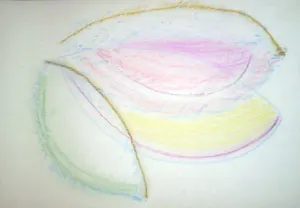
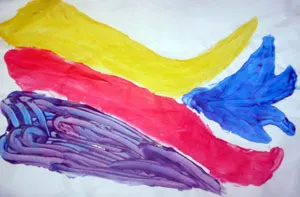
I will try to describe technical and stylistic parameters that reflect what constitutes change during therapy. For example, a transition from using markers to watercolors, or from relatively precise geometric shapes to freer forms, signaling a shift from rigidity to greater freedom — or the reverse: sometimes creating outlines is what the patient needs, and the process of creating boundaries and lines is development for them, an expression of clarity and confidence. The size of the page marks the change in the patient's perception of place and space, and the important experience of being seen or heard more (like the girl who drew a figure larger than usual and then noticed with joy that she was speaking in a louder voice). Sometimes the reduction of objects is necessary as an expression of a more realistic sense of size versus omnipotence. One can also see a transition from invisible colors, like white, to more prominent and varied colors. This change also expresses the artist's feeling of being seen, and that their inner and outer world has become more varied and enriched. The size of the space the object occupies on the page, or the colors chosen — bold or delicate — will have great significance and point to the artist's self-image, their relationship to others, how much they long to be seen or fear being seen. How much they highlight or hide their emotions. For example, some patients fear their own strength (characteristic of anorexia and many women), and the therapeutic work is to accept and channel this strength to more constructive places. These transitions are made as a therapeutic process through the security of the connection created between therapist and patient, ongoing artistic expression, and the shared gaze upon the creation that allows showing in a new way and discovering new things about ourselves.
All these occurrences come to life on paper. The paper serves as a container for all feelings and thoughts. Sometimes as something to be caressed and sometimes as something to be scratched and torn. The materials, accompanied by the therapist of course, succeed in being a container for all positive and negative feelings.
The uniqueness of art that speaks from within, intuitively, like that done within art therapy, allows us a special experience of a window and bridge from our inner world into the concrete, real world, and thereby enables us to understand our inner world better and to some extent connect between the two worlds.
Read More

Art Therapy
Art therapy is an emotional therapy in which one undergoes a process of growth, development, and awareness, with the help of art materials and the power of creation…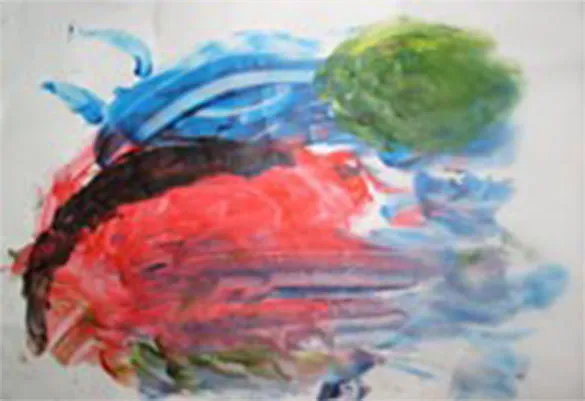
Therapy Demonstration
A demonstration of an art therapy process, step by step, accompanied by drawings and insights from the therapy room…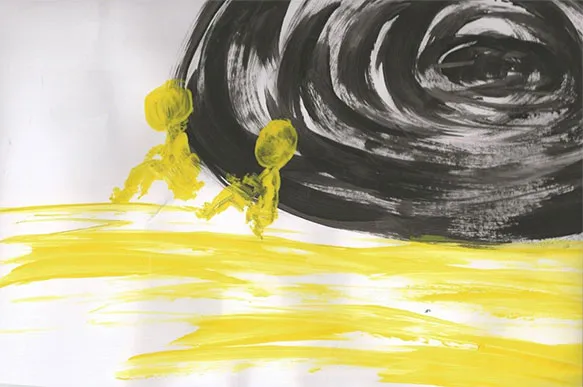
Art Therapy and Focusing
The Focusing approach is based on a process of listening to inner experience, paying attention to body sensations and images that arise…Want to know more?
I'd be happy to meet, answer questions, and help you get started.
Contact us for a consultation and appointment Focused depth meeting